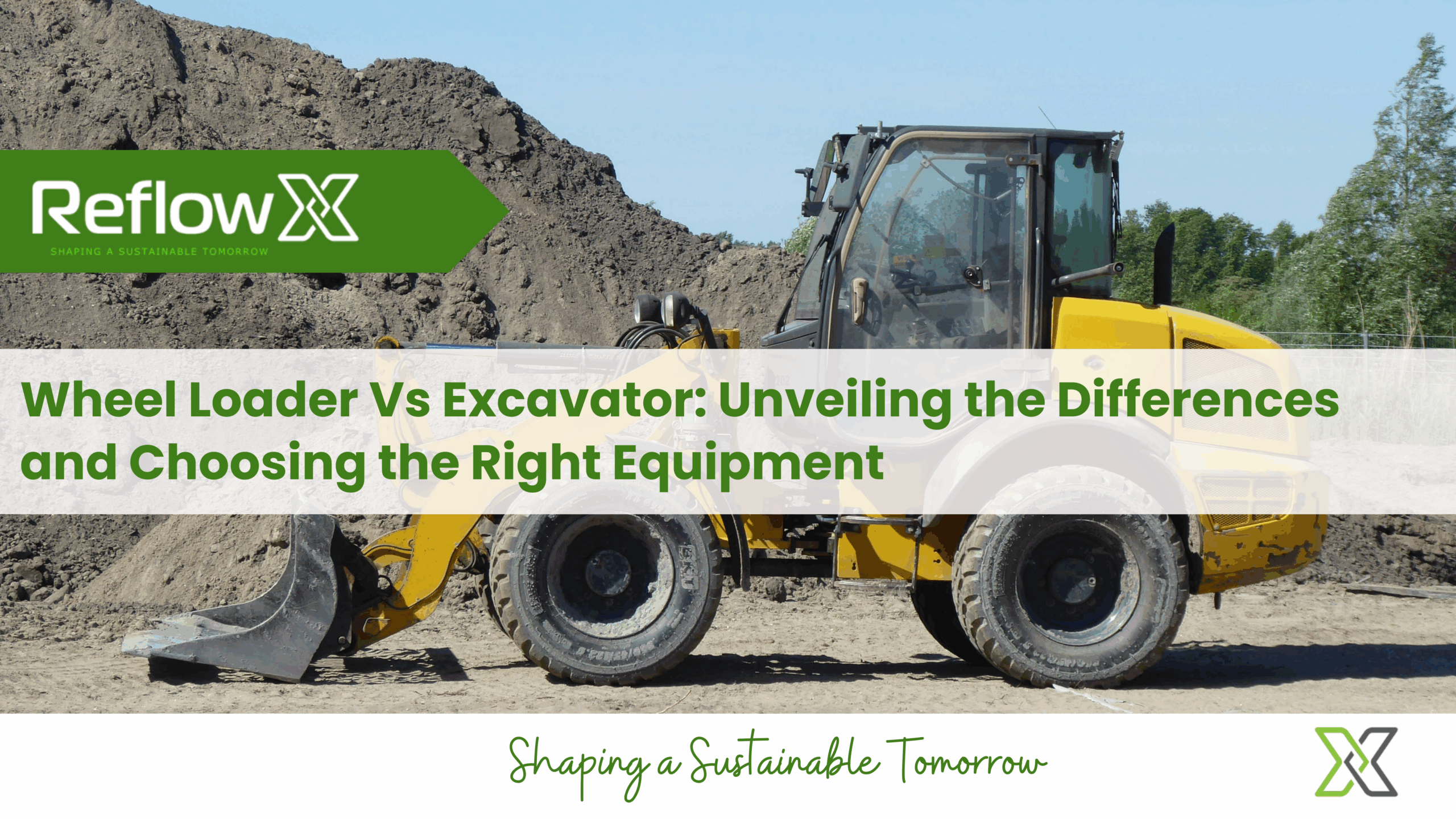
Wheel loaders and excavators as construction equipment are often interchangeably mentioned by the contractors and staff for heavy-duty jobs like load carrying, scooping, digging and demolition. But the differences between them is obvious if you take a closer look at their core functionalities and capabilities. It is important to shed some lights on this wheel loaders vs excavator debate based on what each of them is primarily meant to do and what they are capable of.
Here we are going to break down excavator vs loader debate and explain their functionalities, key differences, use cases and when to choose any of these two options. Let’s start.
Wheel Loader vs Excavator: At-a-Glance Comparison
| Feature | Wheel Loader | Excavator | Winner / Best For |
| Primary function | Scooping, carrying, loading trucks | Digging, lifting with reach, demolition | Task-dependent |
| Digging capability | Fair in loose dirt, poor in hard/compacted ground | Excellent depth, clean walls, high breakout force | Excavator |
| Material handling rate | Extremely fast cycles, high tons per hour | Slower due to swing time | Wheel loader |
| Mobility on site | 25–40 km/h on firm ground | Crawler 4–7 km/h, wheeled up to 35 km/h | Wheel loader on hard surfaces |
| Maneuverability | Good in open areas, no swing | Full 360° rotation, zero-tail options | Excavator in tight spots |
| Typical attachments | Forks, grapples, blades, sweepers | Breakers, thumbs, shears, augers, tiltrotators | Both very versatile |
| Fuel consumption (real) | 18–38 L/hr depending on load & size | 15–42 L/hr depending on hydraulics & idle time | Usually a wash |
| Transport ease | Drives on/off lowbed, rarely needs permits | Wide tracks or boom often require permits | Wheel loader |
| Hourly rental cost (2025) | $130–$360/hr | $150–$480/hr | Wheel loader slightly cheaper |
| Typical environments | Quarries, road jobs, landfills, stockpile yards | Foundations, pipelines, urban work, demolition | Site-specific |
What Is a Wheel Loader, Really?
A wheel boom loader is basically a pickup track with a large carrying bucket attached to its back. To balance the weight evenly, in wheel loaders the engine is placed in the back.
Sizes of a wheel loader vehicle break down roughly like this:
- Compact: 5–10 tons, 0.8–1.5 m³ bucket. This is usually used in landscaping sites.
- Medium: 12–20 tons, 2.5–4.5 m³. It is most commonly used across civil construction sites..
- Large: 25–50+ tons, 6–12 m³ buckets. This large-sized variety is used mainly for quarrying and mining.
Apart from the standard loading bucket, we also come across a variety of attachments such as pallet forks for pipe or lumber, root grapples for land clearing, side-dump buckets for tight spots, and snow plows. Most wheel loaders allow quick coupling and so swapping from bucket to forks takes not longer than five minutes.
What Is an Excavator?
An excavator is built with a rotating upper structure sitting on top of a tracked or wheeled carriage, with a long articulated arm that can reach out, move up and down, dig and demolish obstacles. The cab and engine spin independently of the tracks, which is why you can dig a perfect circle around the machine without ever moving it.
Sizes and variations of an excavator goes like this:
- Mini & compact: 1 to 8 tons capacity. This is good for backyard tidying and urban utility work.
- Mid-size: 15 to 30 tons capacity. This is the most widely used across public utility works and construction sites.
- Large: 40–100+ tons capacity. It is used mostly for mining and mass excavation.
- Wheeled variants: Wheeled variants across sizes are used across city utility projects where you need to drive between small digs.
- Long-reach: The variation with an extended arm is used mainly for riverbank cleanup, deep ponds, and demolition work.
Digging depth and breakout force are the key considerations for choosing one excavator over the other depending on the purpose. A standard 20 to 22 ton crawler will dig 6.5 to 7.2 meters deep and pull 16–20 tons of breakout force at the bucket teeth.
Wheel Loader vs Excavator Differences: Head-to-Head Details
Now let us compare these two equipments in more details, namely, their key features and task handling capabilities, mobility, versatility, fuel footprints and cost.
- Digging and trenching
When it comes to digging a simple drain canal, a wheel loader can end up delivering messy results with low precision and sloppy material handling. An excavator, on the other hand, gives you laser-straight walls, accurate grade, and the ability to set pipe directly from the bucket.
- Loading and material handling
An excavator does a far more time-consuming and less-than-satisfactory job when it comes to loading and ground clearing. A wheel loader is the ideal equipment to load materials and clear ground in construction and public utility sites.
- Mobility and ground conditions
On a paved road job or hard quarry floor, nothing beats a loader for getting around. In contrast, on soup or steep slopes, excavator tracks win every time. Actually you often need the help of excavator to pull of loaders struck in the mud.
- Attachment versatility
When it comes to flexible attachment, the modern variants of both are equally capable. A modern excavator with a hydraulic quick coupler, thumb, and tiltrotator works like a Swiss Army knife for a variety of tasks. Loaders also come with hydraulic forks, grapples, and even 4-in-1 buckets that can clamp and doze.
- Fuel and hourly cost reality
A machine of either type weighing 20 to 25 ton burns roughly 20 to 30 liters per hour for rigorous tasks. During idle times, excavators add up more cost because the pump stays engaged for swing and auxiliary circuits. Loaders, on the other hand, are less expensive for idle times. To optimize budget utilization and cost control, it is important to reduce instances of undercarriage for the excavator trucks.
Wheel Loader vs Excavator: Which to Choose?
Taking a look at some come use case scenarios is important for a more comprehensive understanding of what they are capable of. Let’s discuss a few use case scenarios for both wheel loaders and excavators.
- Landscaping and residential sites
Compact excavator vs compact wheel loader remains to be a recurring small-contractor argument. If you are digging ponds, stumps, or foundations near existing houses, get the mini excavator with zero tail swing. If you are spreading twenty loads of topsoil across half-built lots, the skid-steer-sized or compact wheel loader pays for itself in a week.
- Road building and aggregate
Comparing loader vs excavator for roadwork and demolition is very common. Most highway projects use wheel loaders for stockpile management and truck loading. Excavators are only used for cut sections or drainage. But when it comes to demolition of buildings and big concrete structures, excavators have an edge.
- Pipeline spreads
Excavators dig the ditch and set pipe, wheel loaders string out padding material, haul spoil, and backfill. Trying to do the whole job with only excavators costs a fortune in cycle time.
- Demolition
Excavator on a high-reach arm or with a shear or pulverizer is primarily used for initial breaking. Loaders come into the scene for cleanup, sorting and grappling. The two machines together make the perfect job for such projects.
- Quarry and crusher feed
The vast majority of quarries use wheel loaders for feeding. The speed advantage is just too big when you’re trying to keep a 600-ton-per-hour plant happy.
Frequently Asked Questions
What is the main difference between a wheel loader and an excavator?
A wheel loader is a large-sized mover with big bucket used for loading and shifting big piles of material quickly. An excavator is essentially a digger with extended arm, a smaller but precisely movable bucket. It can rotate and swings to different areas to break heavy concrete and remove materials.
Which machine is better for digging trenches, excavator or wheel loader?
When you need to dig a deep trench with more than a meter of depth, sharp sidewalls and a flat base, an excavator does a far better job. A loader by pushing and scratching can still dig out a whole, but it will be without any precise shape, tidy walls or flat surface at the bottom.
When does it actually make sense to bring in a wheel loader instead of an excavator?
If the job is mostly about moving large piles of materials, loading trucks, cleaning up rubble, or shifting material from one place to another, you can rely on a wheel loader.
Are wheeled excavators as good as wheel loaders at moving material?
Excavators are slower for simple load-and-carry tasks and makes bigger cost as swing if the extended arm adds cycle time. A dedicated loader will is ideal for such tasks as it can move more material per hour.
How do the operating costs really compare between the two machines?
Daily rents for excavators often go higher than what the loaders of similar size is charged for. Over time excavators end up adding cost because of its undercarriage equipments such as rollers, sprockets,and track shoes. In case of loaders, tyres can be expensive, but involves far less cost for rebuilding undercarriage.
Is there a single machine that can handle both digging and serious material handling without big compromises?
On small jobs, a backhoe loader or an excavator fitted with a thumb and grapple will cover a lot of bases. But once the tasks scale up and the production cones into full swing, this hybrid approach shows its limitations such as slow pace of digging than a full excavator and slower loading time than a dedicated loader.
Which attachments transform an excavator the most?
A hydraulic thumb, a tiltrotator and a robust quick coupler change what an excavator can do. With those you can pick, sort, grade and place oddly shaped material in ways a bucket alone cannot.
How should you decide whether to rent or buy a loader or excavator?
In case your uses go up to around 1,400 to 1,600 hours in a year, owning the equipment is more appropriate. But in case the use frequency is lower than this, renting the equipment is more ideas.
Which machine is better for demolition cleanup?
For demolition tasks such as breaking and tearing concrete, the excavator is the right tool. For cleaning up debris and moving them, wheel loaders are ideal.
How much does ground condition matter when choosing between wheeled and tracked machines?
Ground conditions is a key consideration for choosing any of these equipments. On pavement or firm gravel, wheel loaders have an edge because of faster travel speed and less surface damage. But on soft soil, mud, sand and steep ground, the tracks of excavators ensure better traction and stability.
Final Thoughts
Unfortunately, one-size-fits-all approach does not suit well when you need to decide between a wheel loader and an excavator. You should always look for the right tool for the job in front of you. In many cases, to get the job done faster and efficiently, you need to run both of them side by side.
 Prev Blog